Who is this course for?
COMS4105 is taken by a diverse set of students mostly from the School of Electrical Engineering and Computer Science. This includes both engineering and computer science students, from both undergraduate and postgraduate cohorts.
The curriculum is intentionally structured to accommodate and bridge two distinct foundational backgrounds, you only need one or the other:
- Systems & Signal Processing: A background in the signals and systems or mathematical concepts.
- Software & Programming: A background in programming and some experience with either Python or MATLAB.
Most practical exercises require only a few lines of code!
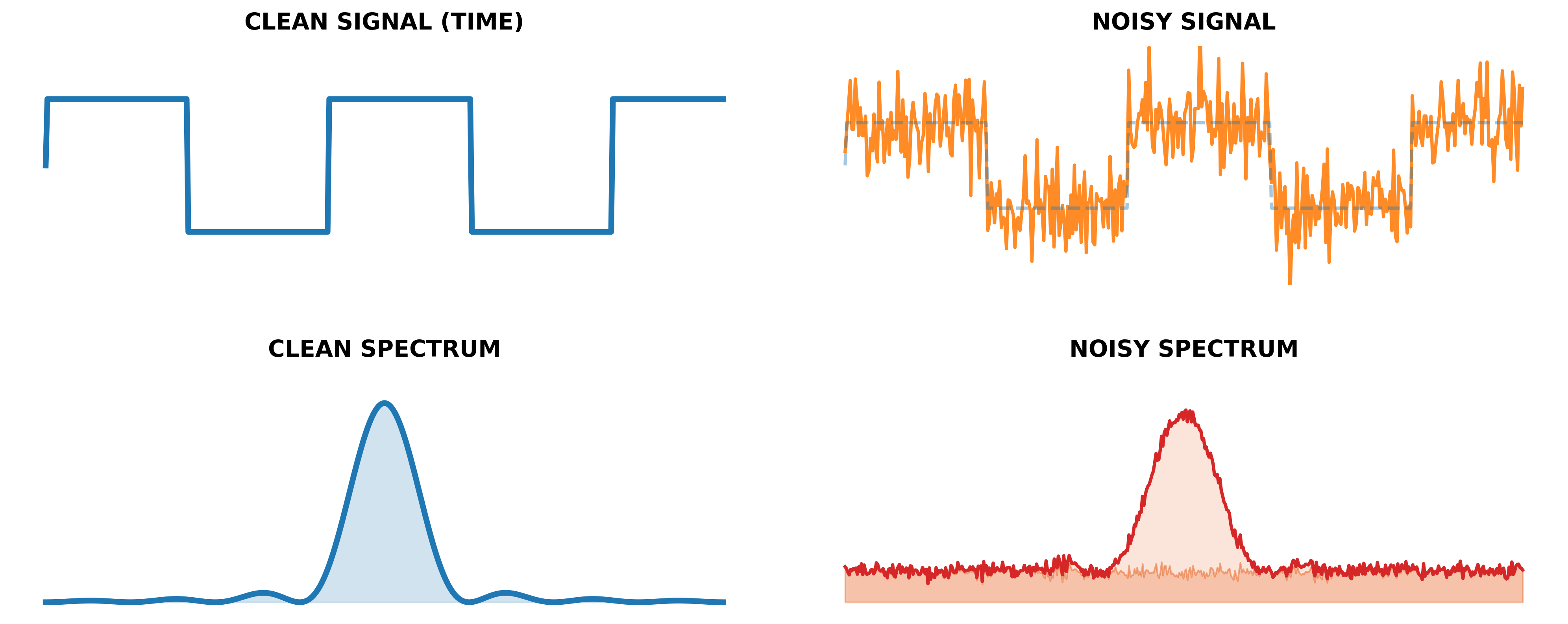
Communication systems need to handle the effect of noise.